Turnkey mainframe migration · AI-driven · Equivalence-gated

Get off the mainframe.
On your terms.

Vectorshift is a complete, governed service for migrating COBOL mainframe estates to a GPU/CPU-enabled cloud. We take your code and documentation, review it, rebuild it, deploy it, migrate the data, test it — and prove, byte for byte, that nothing changed but the platform.

11.9×
GPU speedup at 100M rows, measured on our reference batch
45/45
benchmark records byte-exact against the COBOL reference
~$380/mo
indicative AWS platform cost for a 100M-txn nightly batch
7
governed phases, from code intake to cutover

Why now

The skills cliff

An estimated 220–800 billion lines of COBOL remain in production. The average COBOL developer is in their late 50s, roughly 10% retire every year, and about 70% of universities no longer teach the language.

The cost trajectory

Mainframe software is typically 30–50% of the total mainframe budget, large estates pay roughly $1,000–2,000 per MIPS per year, and pricing keeps trending up.

The exit risk

Migration is the highest-stakes project an enterprise runs. The industry's failures — a UK bank locked 1.9M customers out in 2018 — happened because systems were validated by inspection, not by proof.

We are equally honest about the other side: mainframes are reliable and cheap per workload. Our argument is the skills cliff, the licensing trajectory, and the strategic cost of lock-in — not that the mainframe is broken.

Three paths off the mainframe

The workload's own characteristics decide which path it takes. We deliver all three.

Move off COBOL

Business logic re-implemented in a modern stack — vectorized Python/NumPy, Java services, or GPU-native dataframes. Removes the COBOL dependency entirely, unlocks modern tooling and AI integration.

Take COBOL to the cloud

The same source, compiled by open-source GnuCOBOL on commodity instances, with JCL batch orchestration re-expressed as cloud-native schedulers. Fastest and lowest-risk; modernize function by function later.

The AI-enabled route

AI reads the estate — code, copybooks, JCL, runbooks — extracts business rules, and drafts translations and test suites. Humans review and sign every artifact; the equivalence gate verifies it. AI proposes; the gate disposes.

Workload characteristicPath
High data volume, aggregations, ETL-heavyMove off COBOL — GPU/CPU vectorized tier
Logic-dense, low volume, thin test coverageRehost COBOL on cloud
Regulatory freeze, zero tolerance for changeRehost COBOL on cloud
Medium complexity, staged transitionAI-assisted, then per-function decision

The governed migration cycle

Seven phases. Governance artifacts at every step, inspectable by you at any time.

  1. Grab — we take custody of your code and documentation with provenance and access controls.
  2. Review — AI-assisted analysis builds the function inventory: what each program does, what it touches, what is dead code.
  3. Rebuild — each function is re-implemented, recompiled, or AI-drafted-then-engineered onto its assigned tier. Logic is preserved 1:1 in semantics.
  4. Deploy — functions become containerized jobs on the target platform, orchestrated by a scheduler that preserves batch windows and dependencies.
  5. Migrate data — DB2 tables, VSAM files, and generation datasets move to canonical formats with fixed-point decimal semantics preserved to the cent.
  6. Test — the equivalence gate: every function must reproduce its legacy output byte-for-byte, continuously enforced. One differing byte is a failure.
  7. Roll over — dual-run shadowing against production, reconciliation, then per-function cutover. Every step reversible until sign-off.

Proof, not percentages

Vendors market automation rates — “99.7% automated”. An automation rate is a claim about effort. It says nothing about correctness.

Our acceptance criterion is mechanical: exact fixed-point arithmetic (money stays integer cents, provably exact), byte-exact outputs (field values, totals, ordering, formatting), and continuous enforcement (the check runs in CI, in benchmarks, and during dual-run).

We do not promise a percentage. We promise a measurement.

compare_outputs(legacy, migrated)
final_balances.csv     IDENTICAL
summary_report.csv     IDENTICAL

45/45 records validated
0 mismatches

The evidence

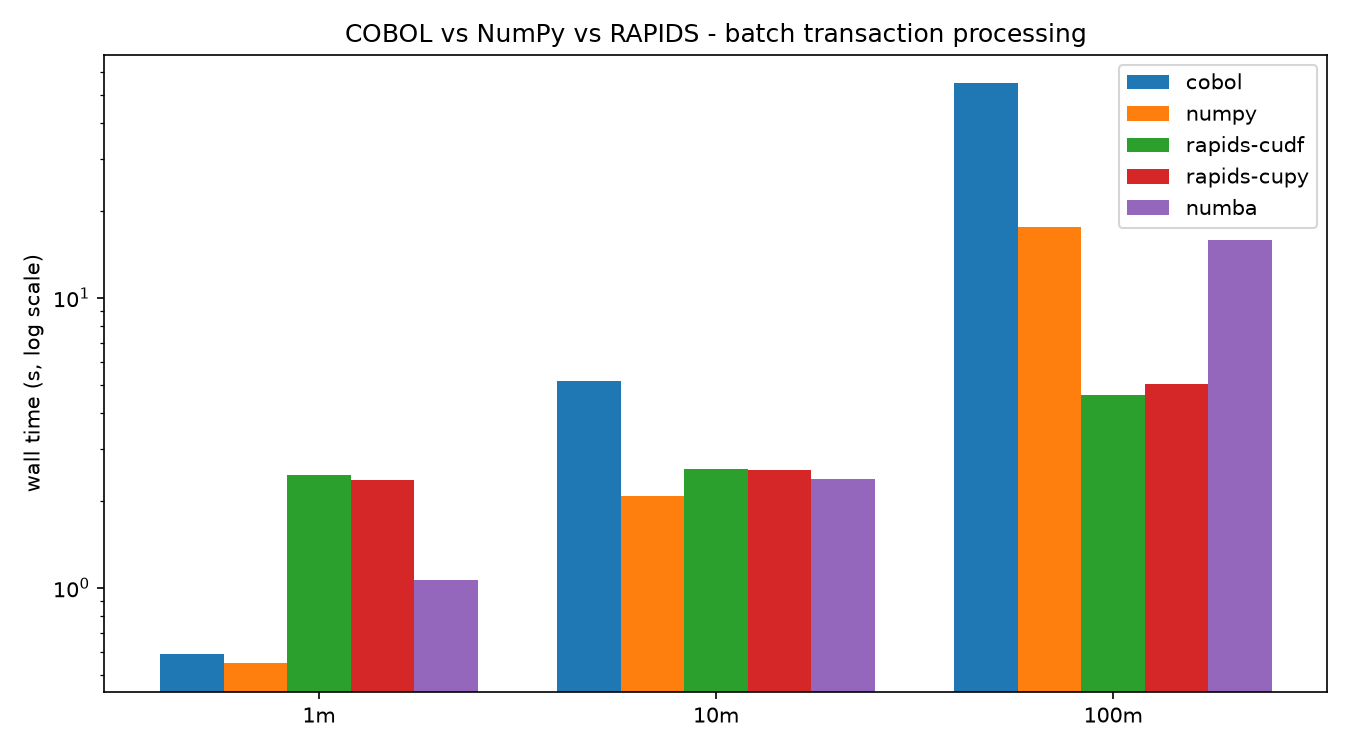
A representative COBOL batch program — per-account aggregation over transaction files — re-implemented four ways and benchmarked at three scales. Three cold-cache runs each. Every output byte-identical to the COBOL reference.

ScaleCOBOL (baseline)NumPy (CPU)RAPIDS cuDF (GPU)RAPIDS cuPy (GPU)Numba (CPU)
1M rows1.00x1.1x0.2x0.3x0.6x
10M rows1.00x2.5x2.0x2.0x2.2x
100M rows1.00x3.1x11.9x10.9x3.5x
Benchmark chart: wall time by scale and backend, log scale

The honest detail: at 1M rows the GPU loses — 0.2x — because transfer overhead exceeds compute savings. We publish the crossover because it is our policy engine: workloads that justify acceleration get GPUs; everything else gets the right tier. You never pay for acceleration that does not accelerate.

Peak-proven scaling

The test every migrated platform must pass: the day demand hits ten times normal. Tax time for a revenue agency. Month-end for a bank.

Online demand

Migrated online workloads become stateless, horizontally-scalable services behind load balancers. Auto-scaling on request rate and latency SLOs; the data tier scales independently. Capacity is rehearsed against replays of captured production peak traffic.

Batch demand

GPU and CPU node pools pre-warm before the season opens and expand with the work queue. Spot fleets add cost-efficient burst capacity for checkpointable jobs; reserved capacity guarantees the floor. Sharded workloads add shards.

The capacity contract

For every peak season we deliver the demand forecast from your run statistics, the capacity plan, the pre-warm runbook, SLOs with alerting — and the seasonal cost model. Peak days become a planned, budgeted, rehearsed event.

Beyond one GPU: workloads shard by business key — account, customer, policy — never by time, preserving inter-row semantics per shard. One L4/L40S-class GPU processes roughly 100M rows of our reference workload in seconds; larger estates partition across GPUs and nodes with near-linear scaling.

The six-month program

A representative estate, end to end, in six months. The calendar is fixed; the scope scales through parallel migration waves — each one safe because every function carries its own byte-exact proof.

Program phaseWeeksWhat happens
Grab + Review (discovery)1–4Code and documentation intake; AI-assisted inventory; hot-path ranking; data-interface catalog; replication test environment
Rebuild + Deploy + Migrate data5–16Parallel migration waves — every function re-implemented or rehosted on its tier and equivalence-proven before it proceeds
Test + shadow run17–20Dual-run against production through a full business cycle, reconciled continuously
Roll over + decommission21–24Per-function cutover, parallel-run sign-off, decommissioning, handover
Managed run (ongoing)25+SLO-managed operation, seasonal peak plans, continuous equivalence monitoring

Indicative economics

The platform

A worked example: nightly batch of 100M transactions, 3 hours of daily processing, one L40S-class GPU instance plus one CPU instance, 2 TB object storage, 200 GB monthly egress.

Roughly $380/month on AWS on-demand, before spot and commitment discounts — an 87–95% reduction against a conservative $3,000–8,000/month mainframe allocation.

Our engagement

Fixed-fee discovery, fixed-fee migration per job tier, optional managed-run support. Fees quote against your assessed function inventory, not hours.

OfferingIndicative range
Discovery (one-off)$150k – $900k
Migration — small job$50k – $120k
Migration — medium job$150k – $450k
Migration — large job$500k – $2M
Managed-run support$10k – $50k / month
Outcome fee (optional)10–20% of measured year-one savings

Acceptance criteria are contractual: byte-exact equivalence and the benchmark evidence. All figures are indicative planning ranges, not quotes.

Start with a discovery

A discovery engagement typically runs 2–6 weeks per workload cluster and produces the function inventory, the data-interface catalog, the test-environment plan, and a fixed-fee migration proposal — with no production change.

Email: [email protected]

Read the comprehensive white paper The Governed Exit (short)